


15 Online Business Ideas to Start With No Money – Profitable 2026 Guide
Starting a business used to mean loans, rent, and a stack of bills before you even made a sale. That’s not how things work anymore. If you want to start an online business with no money, 2026 is shaping up to be one of the best times to do it. All you really need is a laptop, an internet connection, and a willingness to learn as you go.
This guide walks through fifteen online business ideas that cost nothing to start. Some lean on services you can offer right now, others tap into digital products, and a few use marketing and ecommerce models that don’t require holding any inventory. Whatever your skill set, there’s likely something here that fits.
Why Start an Online Business in 2026?

The barriers that used to stop people from starting a business have mostly disappeared. Platforms like Shopify, Fiverr, and Teachable let anyone set up shop in an afternoon, often for free.
According to Forbes, freelance and gig-based work in the U.S. has continued climbing year over year, with millions of Americans now earning income through online platforms in some capacity. That trend isn’t slowing down. If anything, it’s becoming the norm rather than the exception.
Many people use extra income to reach financial goals faster, but it also helps to stop buying things that drain your budget and redirect that money toward growth opportunities.
15 Best Online Business Ideas to Start With No Money
I’ve categorized best online business ideas into three categories. So let’s explore them one by one.
1. Services You Can Offer Right Now.
1. Copywriting

Copywriting is one of those skills that businesses will always need, no matter what’s happening in the economy. In fact, it’s consistently ranked among the best freelance skills to learn for beginners who want to start earning online. Companies are constantly looking for people who can write website copy, email campaigns, product descriptions, and ad scripts that actually convert readers into buyers.
And you know what? The best part is that you don’t need a degree or a certification to get started. You just need to be able to write clearly, understand what makes people take action, and be willing to practice on real projects. Platforms like Upwork and Fiverr let you create a free profile and start applying for jobs the same day, which makes this one of the fastest ways to start an online business with no money.
Earning Estimate:
Let say if you spend around ten hours a week applying for jobs and writing sample pieces. Most beginners land their first paid project within two to four weeks. So, you can earn between $25-30 per project easily.
And believe me, I’m a freelance writer too on fiverr and within 4-6 months of steady work, you as a copywriter can charge from $100 to $300 per project as your portfolio grows with time.
Pros
- Low startup cost.
- Flexible hours
- Skills improve quickly with consistent practice
- Work from anywhere
Cons
- Takes a bit of time to land your first few clients
2. Virtual Assistant Services

Busy entrepreneurs, coaches, and small business owners often reach a point where they’re drowning in emails, scheduling conflicts, and small administrative tasks that eat up their day. That’s where virtual assistant services come in.
As a VA, you might handle inbox management, calendar scheduling, basic bookkeeping, or social media posting, all from your laptop. You can find clients through Facebook groups dedicated to virtual assistant work, or by reaching out directly to small business owners who clearly need help but haven’t hired anyone yet.
Earning Estimate:
Spend five to ten hours a week reaching out to small business owners, and you can expect your first gig within one to three weeks. You’ll likely start around fifteen to twenty dollars an hour.
But after five months of steady client work, bumping your rate up to twenty five or thirty five dollars an hour becomes pretty realistic once you’ve built up some specialized skills.
Pros
- Steady recurring work once trust is built
- No special equipment needed
- Wide variety of tasks keeps it interesting
Cons
- Hourly rates start fairly modest at first
3. Online Coaching

If you’ve got real expertise in fitness, business strategy, language learning, or even time management, online coaching lets you turn that knowledge directly into income. People are willing to pay good money for personalized guidance, especially when it comes with accountability and a clear plan.
Zoom works fine for one on one or group sessions at no cost for shorter calls, and Calendly handles all your booking and scheduling without charging a dime on the free plan.
The key is being specific about who you help and what results they can expect.
Earning Estimate:
Give yourself 3 to five weeks to put together a simple offer and start talking about it online before your first paying client shows up. You’ll probably charge fifty to one hundred dollars per session at first.
Once you’ve worked with five to ten people and collected a few testimonials, raising your rate to one hundred fifty or two hundred dollars within three to six months won’t feel like a stretch.
Pros
- High earning potential per hour
- Builds your personal brand and reputation over time
- Deeply rewarding work
Cons
- Requires consistent marketing to keep your calendar full
2. Digital Products and Content
4. Affiliate Marketing
Affiliate marketing as a beginner is one of the most talked-about ways to earn online, and for good reason. You recommend products or services you genuinely use or believe in, share a unique link, and earn a commission whenever someone makes a purchase through that link.
This works especially well if you’re already creating content on a blog, YouTube channel, or social media, since you’re simply adding monetization to something you might be doing anyway.
The trick is choosing products that actually fit your audience instead of promoting anything just for the commission.
Earning Estimate:
If you’re posting content three to five times a week, your first commission usually shows up within one to two months. Don’t expect much at first, most beginners earn under one hundred dollars a month early on.
But if you keep going for six months to a year and build an audience of even a few thousand people, monthly income often climbs into the several hundred to low thousands range.
Pros
- No product creation required
- Highly scalable
- Commissions can be passive once content is published
Cons
- Takes time to build enough traffic for meaningful income
5. Selling Digital Products

Digital products like ebooks, printable planners, social media templates, and resume designs are some of the easiest things to sell online because you create them once and sell them over and over without any additional production cost.
Gumroad lets you list products for free and only takes a small fee per sale, while Etsy charges a small listing fee but gives you access to a massive built in audience already searching for digital downloads.
The upfront work is creating something genuinely useful, but after that, sales can come in while you sleep.
Many creators start by selling ebooks and templates, while others focus on building passive income from Etsy printables that can generate sales around the clock.
Earning Estimate:
Plan on one to two weeks to create your first product and get your shop set up. Your first month might bring in fifty to one hundred dollars from a handful of sales. Keep adding products and let your shop get discovered through search, and six months in, three hundred to five hundred dollars a month is a fair target if you stay consistent.
Pros
- Passive income potential
- Low overhead
- Scalable across multiple products
Cons
- Initial creation phase takes focus and time.
6. Print on Demand Business

A print on demand business lets you sell custom designed shirts, mugs, tote bags, and more without ever holding inventory or shipping a single item yourself. You create the design, upload it to a platform like Printify, free Shopify or Etsy store.
That’s how the platform handles printing, packaging, and shipping whenever someone orders. This makes it one of the most accessible ways to get into ecommerce without stock sitting in your garage.
Earning Estimate:
If you work on this a few evenings a week, setting up your store and uploading your first designs takes about a week. Your first sale could come within two to four weeks depending on how much you promote it. Many sellers see two hundred to four hundred dollars a month within three months, and that number tends to grow as you build out a niche.
Pros
- No upfront inventory costs
- Full creative freedom over designs
- Easy to test multiple niches
Cons
- Profit margins per item tend to be on the slimmer side
7. Dropshipping Store
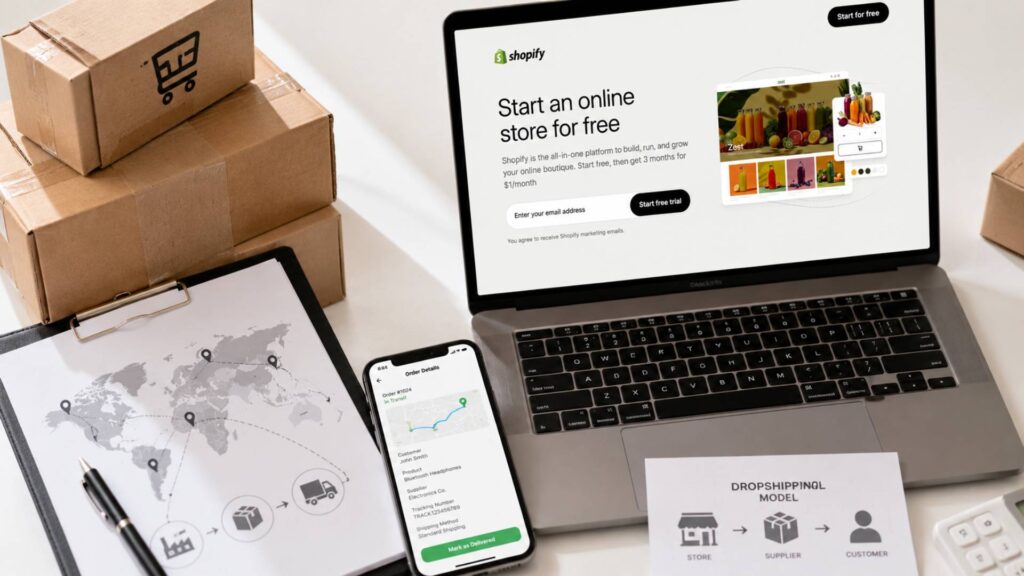
Dropshipping store models let you run a full online shop without ever touching the products you sell. Shopify offers a free trial to get your store running, and apps like Oberlo or Spocket connect you directly to suppliers who ship products to your customers under your branding.
Your main job becomes choosing good products, writing compelling listings, and running ads or organic content to drive traffic to your store.
Earning Estimate:
Give yourself one to two weeks to research products and get your store live. The first month is mostly testing, so don’t be surprised if you’re just breaking even or pulling in a few hundred dollars.
Once you find a product that works and refine your approach, five hundred to one thousand dollars a month in profit by month three or four is achievable.
Pros
- Low entry cost
- Huge product selection to choose from
- Easy to launch within days
Cons
- Finding reliable suppliers can take some trial and error early on
8. Start a Blog

Blogging income comes primarily from a mix of display ads, affiliate links, and occasionally sponsored posts once your blog gathers steady traffic. WordPress.com offers a free starter plan, which is more than enough to get your few first posts published.
The real investment here isn’t money, it’s time spent researching keywords, writing helpful content, and being patient while search engines index and rank your pages.
Earning Estimate:
Write two to three posts a week for the first three to six months, and don’t expect much income during that stretch, it’s mostly about building up content and waiting for search engines to catch on.
Once you’re getting a few thousand visitors a month, usually around the six to nine month mark, you can expect somewhere between one hundred and five hundred dollars a month from ads and affiliates combined, with room to grow well beyond that over time.
Pros
- Builds long term passive income
- Establishes you as an authority in your niche
- Content keeps working for years
Cons
- Growth is slow during the first several months
9. Start Your YouTube Channel

Whether you go faceless with tutorials, animations, or compilation style videos, or you show your face while teaching a skill you know well, YouTube remains one of the strongest platforms for building a content creator brand from scratch.
A smartphone camera and free editing software like CapCut are genuinely enough to produce videos that look professional. The platform itself handles distribution, which means your videos can be discovered by new viewers for years after you publish them.
Earning Estimate:
Plan on uploading one to two videos a week for the first 4 to 6 months while you build an audience, and most creators earn nothing during that time.
Once you hit the requirements for monetization around 500 subscribers and 3k hours of watch time, you’ll start earning from ad revenue. Sponsorships start becoming an option once you’ve found your footing in your niche.
Pros
- Massive reach potential
- Multiple monetization streams beyond ads
- Videos continue earning long after upload
Cons
- Building an audience large enough to monetize takes sustained effort
3. Marketing and Specialized Skills
10. Become a Community Manager

Brands, course creators, and online businesses increasingly rely on someone to manage their online communities, whether that’s a Discord server, a private Facebook group, or a subscriber base on a platform like Skool.
As a social media manager or community manager, your job becomes acting as the bridge between the brand and its audience, answering questions, sparking discussions, and keeping the space active and welcoming.
This role often starts part time and can grow into a steady source of income as the community expands.
Earning Estimate:
Reach out directly to brands or creators who could use the help, especially smaller ones, and you’ll likely land your first role within two to three weeks.
Part-time work usually starts at five hundred to one thousand dollars a month for a few hours a day. Take on more communities or bigger brands, and that number climbs naturally.
Pros
- Builds relationships and reputation quickly
- Often flexible and part time friendly
- Opens doors to other opportunities
Cons
- Requires being responsive during active community hours
11. Graphic Designing

If you’ve got an eye for color, layout, and visual storytelling, freelance graphic design work is everywhere right now. Businesses need logos, social media graphics, presentation decks, and marketing materials constantly.
And many of them don’t have an in house designer. Canva’s free tier is genuinely powerful enough to create professional looking designs for clients, especially when paired with free stock photo sites and font resources.
Earning Estimate:
Spend your first one to two weeks putting together a small portfolio, even mock projects work fine, then start applying for jobs. You’ll likely charge twenty five to seventy five dollars per project and land your first paid gig within two to four weeks.
Three to six months in, with a stronger portfolio behind you, moving up to one hundred to three hundred dollars per project, especially for branding work, is well within reach.
Pros
- Creative and varied work
- Strong demand across nearly every industry
- Portfolio grows with every project
Cons
- Building an initial portfolio takes a bit of upfront effort
12. Online Course Creation

Online courses passive income is one of the most rewarding models. Once everything is set up, a single course can sell to hundreds of people without any additional work on your part per sale.
Teachable’s free tier lets you host and sell courses without paying any upfront platform fees, which makes it genuinely accessible for anyone with knowledge worth packaging.
The biggest investment here is time spent while planning your curriculum and recording lessons.
Earning Estimate:
If you work a few hours each evening, outlining your course and recording lessons takes about two to four weeks. Your first sales often come from people who already follow you, and many creators bring in a few hundred dollars in that first month.
Pros
- Highly scalable
- Builds authority in your field
- Creates a long term asset
Cons
- Creating the actual course content takes a meaningful time commitment upfront
13. Translation Services
If you’re bilingual or fluent in multiple languages, translation services are in steady and growing demand as businesses expand internationally. Platforms like ProZ and Gengo connect translators with clients needing documents, websites, marketing materials, or app content translated accurately.
This work tends to be reliable because language needs don’t disappear, and once you build a relationship with a client, repeat work is common.
Earning Estimate:
Setting up profiles on translation platforms takes a few hours, and most bilingual freelancers land their first project within one to two weeks.
You’ll likely start at fifteen to thirty dollars an hour. Put in ten to fifteen hours a week, especially if you specialize in technical or legal translation, and your rate could climb to thirty five or forty dollars an hour within six months.
Pros
- Flexible hours
- Steady demand across many industries
- Repeat clients are common
Cons
- Rates can vary depending on how common your language pair is
14. Create a Solo Podcast

Online tutoring isn’t the only audio based path worth considering. A solo podcast built around a specific niche topic, whether that’s personal finance, true crime, parenting, or career advice, can attract sponsorships once you build a steady and engaged listener base.
Free tools like Anchor let you record, edit, and distribute episodes to every major podcast platform at no cost, which means your only real investment is consistency and a decent microphone if you decide to upgrade later.
Earning Estimate:
Plan on publishing weekly episodes for three to six months before sponsors even start paying attention. During that stretch, expect little to no income, though some listeners might send small donations.
Once you’re consistently getting a few hundred downloads per episode, small sponsorships often start around fifty to two hundred dollars per episode and grow as your audience does.
Pros
- Builds a loyal personal brand
- Sponsorship opportunities grow naturally with audience
- Low ongoing cost
Cons
- Growing an audience large enough for sponsors takes patience
15. Digital Art Sales

If you create digital art, whether that’s illustrations, patterns, or digital paintings, platforms like Shutterstock and Etsy let you upload your work and sell it to a global audience without paying any listing fees on Shutterstock.
This is a great option for artists who already create regularly and want their existing work to start generating income passively, since each piece can be sold an unlimited number of times once uploaded.
Earning Estimate:
Uploading a starter portfolio of fifteen to twenty pieces takes about one to two weeks if you’re working with art you’ve already made. Expect twenty to fifty dollars a month at first while your work gets discovered.
Keep adding five to ten new pieces a month, and within six months, fifty to three hundred dollars a month is a reasonable goal as your catalog builds up.
Pros
- Passive income from one time uploads
- Global audience reach
- No inventory or shipping involved
Cons
- Individual sale payouts tend to be small
Frequently Asked Questions
Do I really need 0$ to start any of these businesses?
Yes, and that’s the encouraging part. Every idea on this list has a free entry point, whether that’s a free platform tier, free software, or simply your own time and skills. That said, reinvesting early earnings into better tools or marketing can speed up growth considerably.
Which online business idea makes money the fastest?
Service based businesses like copywriting, virtual assistant work, and graphic design bring in income the quickest because you’re trading skills for payment right away. Digital products, blogs, and YouTube channels usually take longer since they rely on building an audience first.
What if I don’t have any special skills yet?
That’s more common than you might think, and it’s not a dealbreaker. Many successful freelancers and creators learned their skills through free resources like YouTube tutorials and online communities. Starting small while learning is often the best way to build both confidence and income at the same time.
Wrapping Up!!
There’s never been an easier time to start an online business with no money. Whether you lean toward freelance online business work, digital products, or content creation, the tools to get started are sitting right in front of you, often for free.
If you’re working with limited funds while building toward something bigger, check out 10 Wealth Building Mistakes That Keep People Broke for practical ways to avoid common financial pitfalls along the way. The best time to start is now, and the only real investment required is your effort.