


The Maybe Box Method for Things You Can’t Decide to Keep
Every home has that one drawer, closet shelf, or storage bin filled with things you can’t quite let go of but also don’t really need. A college textbook you’ll probably never open again. A gift from someone you barely talk to anymore. A gadget that seemed useful once but hasn’t left its box in years. These items sit in limbo because deciding their fate feels harder than it should.
The Maybe Box Method solves this problem without forcing you into an uncomfortable yes or no on the spot.
It’s a simple, low pressure decluttering method that gives you permission to delay a decision instead of making a bad one out of guilt or hesitation. This approach has quietly become one of the most practical tools for anyone trying to declutter your home without the emotional exhaustion that usually comes with it.
What Is the Maybe Box Method
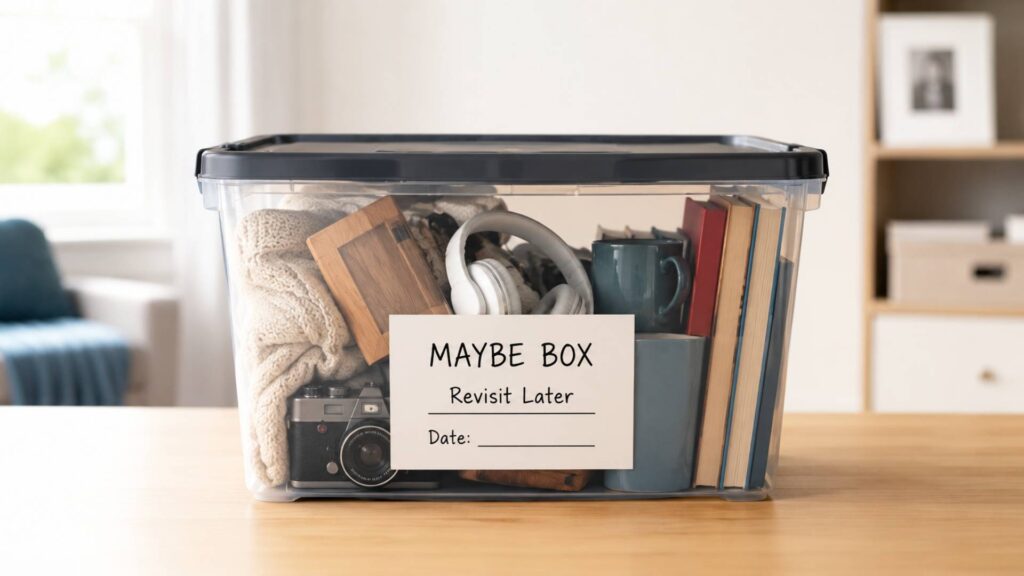
When you come across an item you can’t decide to keep, you don’t force an immediate choice. Instead, you place it in a labeled box, write today’s date on it, and put the box somewhere out of sight for a set period. That simply is your Maybe Box.
Here’s the basic process:
- Find an item that creates hesitation, not clear yes or clear no
- Place it in a box or bin labeled with today’s date
- Store the box somewhere out of daily sight
- Set a return date, typically three to six months out
- Revisit the box only when that date arrives
If you never think about the item again during that window, you’ll know it wasn’t as important as it felt in the moment, and you can donate or toss it without a second thought. If you find yourself actively looking for it, you pull it out and keep it permanently. The Maybe Box Method turns an emotionally loaded decision into a simple test of time.
According to a study published in the Journal of Consumer Research, people consistently overestimate how much they’ll miss an item after getting rid of it, a phenomenon researchers call the endowment effect.
The Maybe Box Method sidesteps that fear entirely by removing the finality from the decision.
Why Decision Fatigue Ruins Most Decluttering Attempts

Anyone who has tried a big decluttering session in one weekend knows how quickly it falls apart. The first hour feels productive. By hour three, every item starts to look sentimental, useful, or “maybe worth keeping just in case.” That shift isn’t laziness. It’s decision fatigue, a well documented psychological state where the quality of your choices declines the more decisions you’re forced to make in a row.
This is exactly why traditional decluttering tips that rely on making a firm yes or no choice for every single item often fail. You start strong and end up keeping things you don’t actually want simply because you’re too mentally drained to evaluate them properly.
Signs decision fatigue is affecting your decluttering session:
- You start keeping things “just in case” more frequently as the session goes on
- Every item suddenly feels sentimental, even ones you barely remembered owning
- You feel exhausted rather than accomplished after an hour or two
- You avoid finishing the pile and shove it back into storage instead
The Maybe Box Method removes that pressure. Instead of forcing a final answer under fatigue, you create a legitimate middle category. This alone makes the entire process of organizing your home feel less overwhelming, since you’re not demanding total clarity from yourself in a single afternoon.
Simple Living Habits That Save Time and Energy covers several other approaches to reducing daily decision fatigue that pair well with this method.
How to Set Up Your Maybe Box System
Getting started takes less effort than most people expect. You don’t need special containers or a complicated system, just a few clear boundaries so the method actually works instead of becoming another pile of stuff you ignore.
1. Choose the Right Container
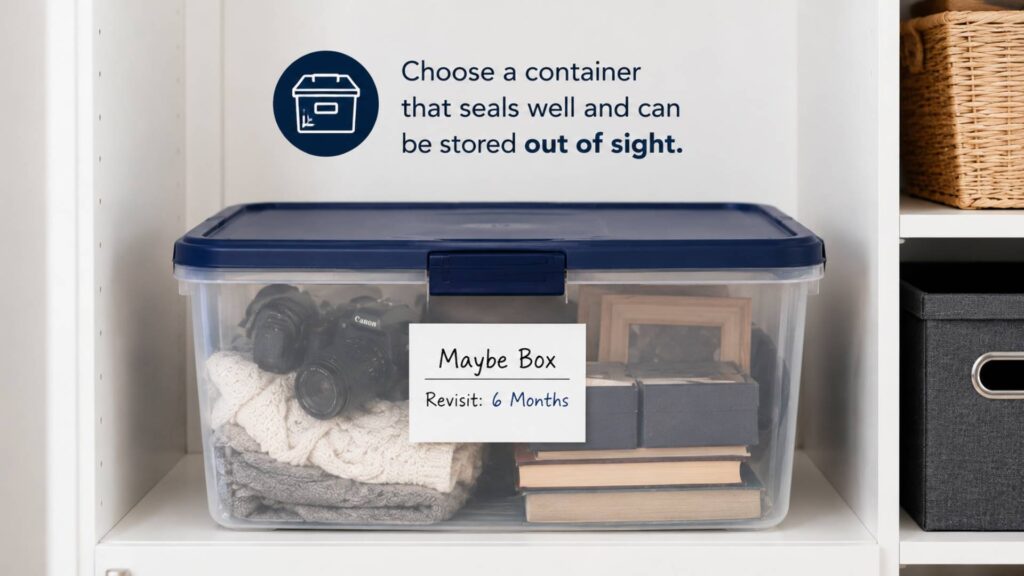
Pick a box, bin, or storage container that’s easy to seal and store out of your regular living space. A closet shelf, garage corner, or basement works well. The goal is out of sight, since seeing the box daily defeats the purpose of testing whether you actually miss what’s inside.
2. Set a Clear Time Limit
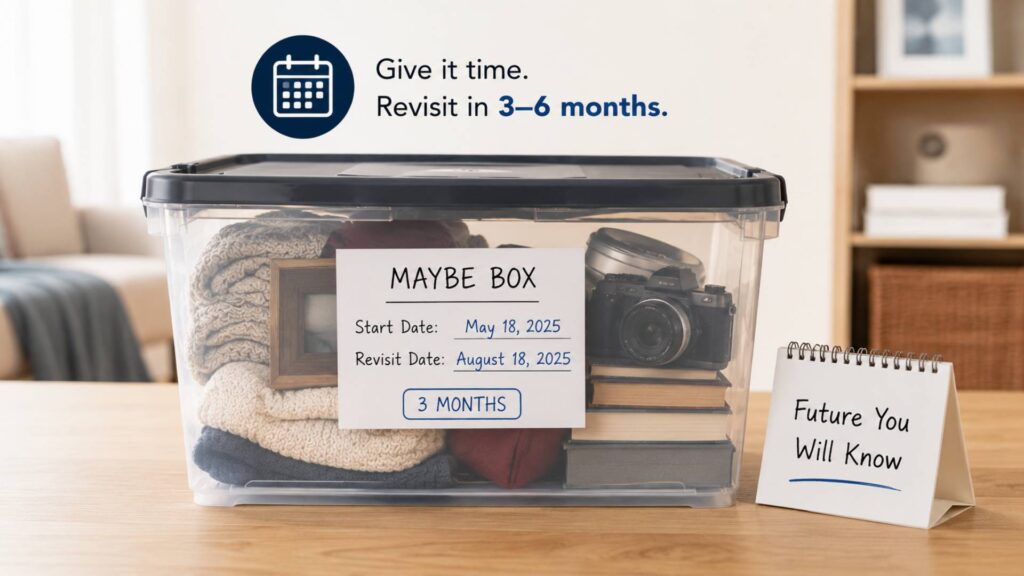
Write the start date directly on the box, along with the date you plan to revisit it. Three months works for most people, though sentimental items sometimes benefit from a longer six month window. Shorter than that and you won’t get an honest read on what you actually miss.
3. Create Simple Rules for What Goes In
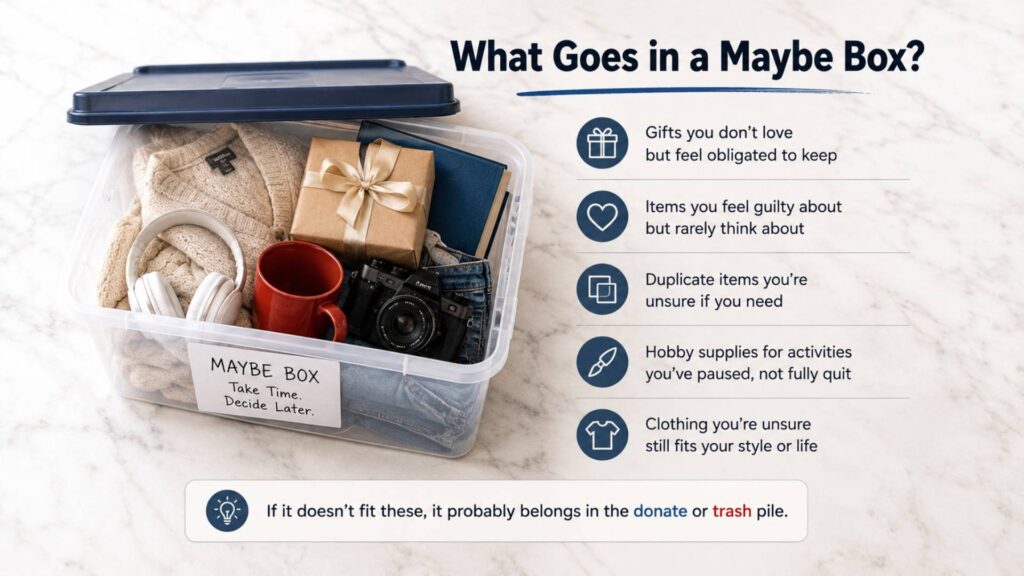
Not everything belongs in a Maybe Box. This method works best for:
- Items you feel guilty about but rarely think about
- Gifts you don’t love but feel obligated to keep
- Duplicate items you’re unsure if you need
- Hobby supplies for activities you’ve paused, not fully quit
- Clothing you’re unsure still fits your style or life
Items that clearly belong in the trash, recycling, or donation pile from the start shouldn’t go into the box. The Maybe Box is for genuine uncertainty, not procrastination dressed up as a system.
For sentimental items specifically, taking a photo before letting go preserves the memory without requiring physical storage space. 7 Daily Habits That Prevent Clutter offers additional strategies for keeping new clutter from building back up once you’ve cleared the old.
Making the Maybe Box a Long Term Habit
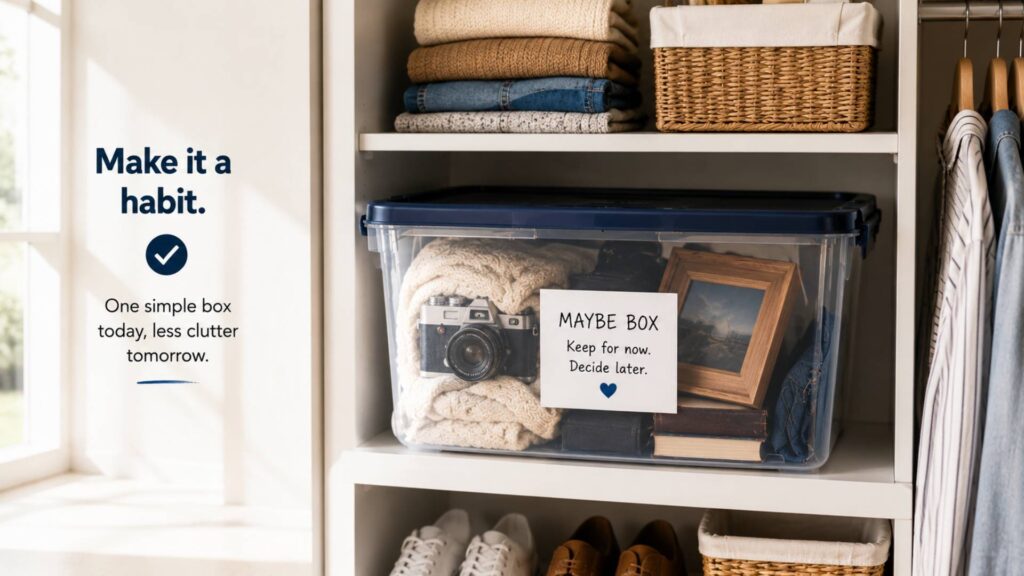
The real value of this system shows up when it becomes a permanent fixture in your home rather than a one time decluttering project. Keep an active Maybe Box going at all times, and any item that creates hesitation goes straight into it rather than back into a drawer.
Over time, this builds a habit of catching clutter before it accumulates rather than dealing with it in overwhelming bulk later. It fits naturally into a broader minimalist lifestyle, where the goal isn’t extreme minimalism but rather intentional ownership of things that genuinely serve your life. Start Simple Living in a Fast Paced World dives deeper into building this kind of intentional approach across your entire home, not just your storage spaces.
Once your spaces open up, a decluttered home creates the perfect blank canvas for a calmer, more considered redesign. Cozy Bedroom Ideas to Elevate Your Space is worth exploring for turning that new breathing room into something intentional.
Maybe Box vs Donation Box
Although they may look similar, a Maybe Box and a donation box serve different purposes. A Maybe Box is meant for items you’re genuinely unsure about keeping. It gives you time to decide without the pressure of making an immediate choice.
A donation box, on the other hand, is for belongings you’ve already decided to let go of and plan to donate. Using both methods together can make decluttering easier, helping you reduce decision fatigue while ensuring your home becomes more organized over time.
Maybe Box
- Holds items you’re unsure about
- Temporary storage
- Decision is delayed
- Helps reduce decluttering regret
- Reviewed after a set time (e.g., 30–90 days)
Donation Box
- Holds items you’ve decided to give away
- Permanent removal
- Decision is already made
- Frees up space immediately
- Donated as soon as possible
FAQs
How many Maybe Boxes should I have at once?
One active box per room is plenty for most homes. Having too many at once tends to dilute the method and makes it harder to track what you’re actually testing.
What if I regret donating something later?
This happens rarely once the time limit has genuinely passed. If regret does show up, treat it as useful information for future decisions rather than a failure of the method.
Can this method work for sentimental family items?
Yes, and it often works especially well here since sentimental guilt is exactly the kind of hesitation this system is built to sort through honestly over time.
Final Thoughts!
The Maybe Box Method works because it respects how people actually make decisions instead of fighting against it. Uncertainty isn’t a personal failing, it’s a normal part of owning things that matter to you in some way. Giving yourself a structured, time based way to resolve that uncertainty turns decluttering from an emotional battle into a simple, almost automatic process.
Start with one box, one shelf, and one honest three month window. A clutter-free home rarely happens through a single dramatic purge. It happens through small, low pressure systems like this one, repeated consistently until intentional living just becomes how your home naturally works.